



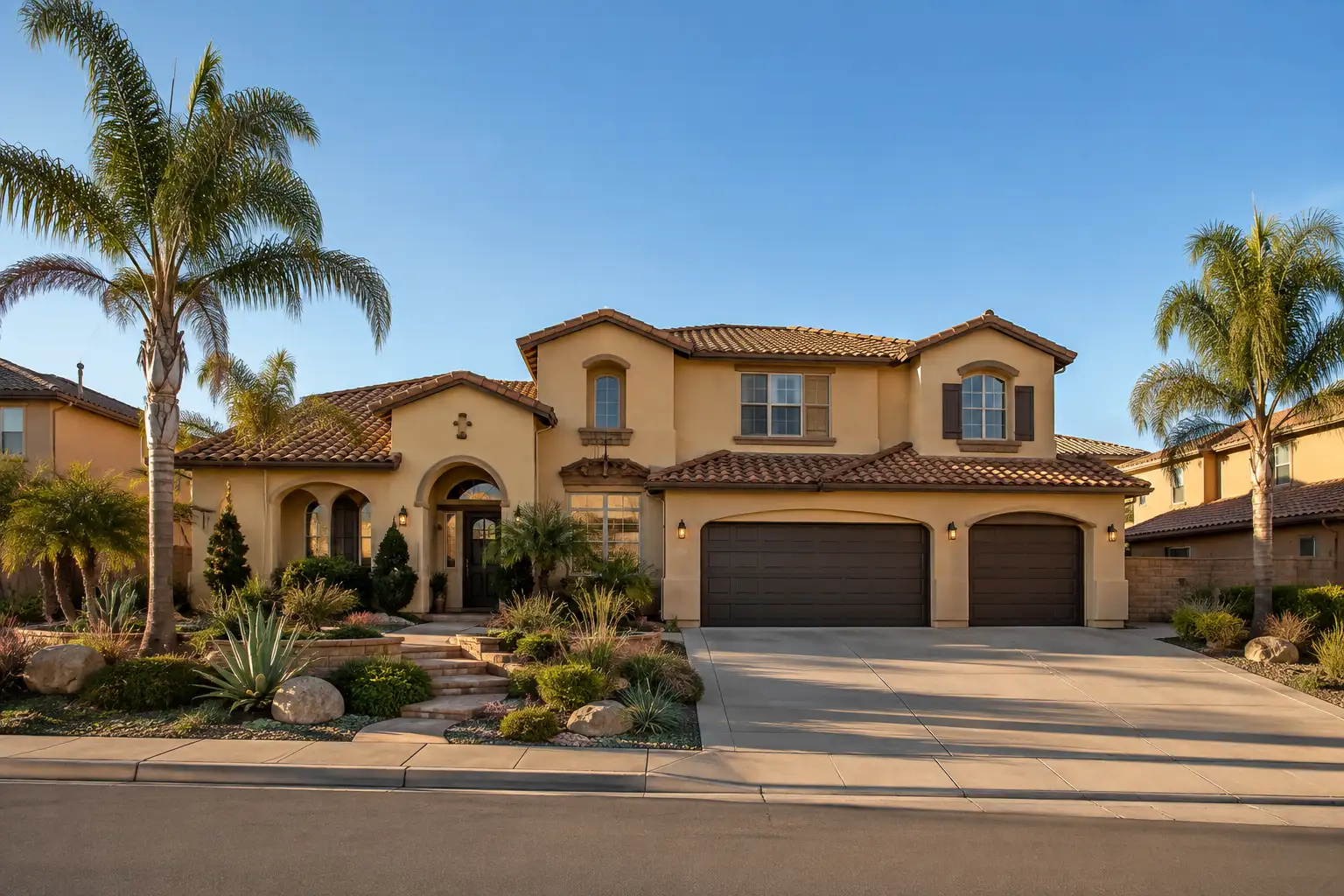
You are looking at a Lawndale house, and a downspout ends beside the foundation or empties toward the street. Or you own the property and want to change the roofline, build an addition or start a larger remodel. The practical question is simple: where is that roof water supposed to go?
Lawndale Municipal Code Section 15.04.130 says water from the roof of all buildings shall be carried by conductors under the sidewalks and through the curb into the gutter. It also provides two exceptions, including one tied to the distance between certain buildings and the street property line.
This is general information and not legal advice.
What does Lawndale require for roof drainage?
Lawndale requires roof water to travel through conductors under the sidewalks and through the curb into the gutter, unless one of the section’s exceptions applies.
The rule appears in Municipal Code Section 15.04.130, “Section 1503.4 amended-Roof drainage.” It amends Section 1503.4 of the California Building Code as adopted by reference through the county building code.
The section also says overflows shall be installed at each low point of the roof to which water drains. Concealed roof-drainage pipes shall be installed as required for soil, waste or vent piping.
This is a Lawndale amendment, not a claim about how every California city handles roof drainage. The city’s broader adoption language says the 2025 California Building Code, as amended by Title 26 of the Los Angeles County Building Code, together with their appendices, is adopted as Lawndale’s building code. Copies are kept at the city clerk’s office.
You can read the language in the city’s Building Code chapter on eCode360. The code page states that it includes legislation through Ordinance No. 1212-26, adopted March 2, 2026. That statement does not establish the effective date of the 2025 code adoption.
Which buildings have a setback exception?
Buildings in occupancy groups R or M need not follow the roof-conductor requirement when their walls are ten feet or more from the street property line.
Section 15.04.130 does not define those building-code occupancy groups, so confirm the classification with the city.
The section also does not explain how the ten-foot measurement applies to a corner lot, a property with an alley or a lot without a sidewalk. Ask the city which street property line and measurement control for the particular site.
A buyer should not assume that a house qualifies merely because it appears set back from the curb. The quoted reference point is the street property line, not the curb, sidewalk edge or front wall of a neighboring building.
Can the City Council grant a waiver?
The Lawndale City Council may waive the requirement in cases of hardship or when compliance is impractical because of terrain, building location or other physical factors.
The council may also impose conditions it considers necessary when granting that waiver. The section assigns this decision to the City Council, not simply to city staff.
This section does not describe a waiver form, review fee, processing time or record of approvals and denials. Before designing around a waiver, ask the city about the current process and required supporting material.
The rule is not new to the latest code cycle. Its history line includes Ordinance 862-99, so the provision dates to at least 1999.
What should a buyer or seller check at the property?
A buyer or seller should identify where each downspout discharges and compare any planned work with the language in Section 15.04.130.
Look at the visible path rather than assuming a pipe reaches the gutter. Ask where the conductor goes, whether it passes under the sidewalk, and where it exits. If a front addition, new building or roofline change is planned near the street, ask the city how the amended Section 1503.4 applies and whether an exception or waiver is relevant.
Do not turn that check into a retrofit claim. The cited section does not say that an existing house must be changed, and it does not establish a sale inspection requirement.
For other Lawndale-specific planning topics, keep the roof rule separate from the city’s ADU ordinance guide and the home improvement rebate and residential property report guide.
A Lawndale owner told us he planned to redirect a downspout toward the side property line to stop water from collecting near the foundation. The change would protect one part of his house but could send runoff toward the neighboring property. We reviewed where the city allowed roof water to discharge before he extended the drain.
Does work at the curb require an encroachment permit?
The cited code does not say that cutting through a curb for a roof drain requires an encroachment permit, so ask the city about the proposed work.
Lawndale Municipal Code Chapter 12.04 is titled “Street Encroachment Permits.” Section 12.04.010 adopts the Highway Permit Ordinance of the County of Los Angeles, as it existed on November 2, 2000, as the city’s highway permit ordinance in conjunction with other applicable Lawndale ordinances.
That adoption alone does not show which permit, if any, applies to a particular roof-drain project. The contents of the county Highway Permit Ordinance were not part of the reviewed material. Nor does the roof-drainage section identify who inspects curb work or what such work costs.
Treat the building-code requirement and permission to perform work in or near the street as separate questions for the city. Insider also covers remodel rules in other cities, including Bellflower’s underground utility lines guide.
What other Lawndale building amendments matter?
Lawndale also requires four sets of plans and specifications with each building application.
Section 15.04.120 says those four sets must cover the work to be performed at the job site. They must accompany any other information needed to determine compliance with local and state laws and regulations.
That is a separate local amendment from the roof-drainage rule, but it matters when preparing an addition or remodel application. It gives you a concrete submission number to confirm with the city before filing.
Title 15 also contains chapters for electrical, mechanical, plumbing, fire, residential, existing-building and green-building standards. Another chapter addresses an expedited permit process for small residential rooftop solar energy systems. Those chapter headings establish that the subjects are covered, but they do not supply project-specific requirements here.
How are moved buildings reviewed?
A building proposed for relocation goes through a Planning Commission process after review by the building official and community development director.
Under Section 15.04.140, the building official reports whether the structure admits of practicable and effective repair and recommends whether a relocation building permit should be issued. The community development director sets a Planning Commission hearing within 45 days after the report is submitted.
Notice goes by first-class mail to the applicant and owners of record within 300 feet of the proposed site. The commission may approve, conditionally approve or disapprove the permit. Its required findings address how the building fits the lot and its compatibility with surrounding structures and the neighborhood.
All work must be completed within 90 days after the permit is issued. The building cannot be occupied, and gas and electricity cannot be connected, until the work is complete. A satisfactory termite-clearance report must be presented to the Planning Commission.
The section adds a $200 administrative fee to other building-code fees. An aggrieved person may appeal to the City Council.
The short version
Lawndale’s rule says roof water from all buildings shall travel through conductors under sidewalks and through the curb into the gutter, subject to two stated exceptions.
One exception covers buildings in occupancy groups R or M whose walls are at least ten feet from the street property line. The other allows the City Council to grant a conditioned waiver for hardship or when physical factors make compliance impractical.
Check where the property’s downspouts discharge, but do not assume the code requires an existing house to be retrofitted at sale. For proposed work, ask the city how the rule applies, whether curb work needs separate permission, and whether four plan sets remain part of the application process.
If a roofline, addition or drainage question affects your plans for the property, start with the code and the city, then review the property’s broader context with the home value tool.
Common questions
Does Lawndale require roof water to pass through the curb?
Section 15.04.130 says roof water from all buildings shall be carried by conductors under sidewalks and through the curb into the gutter, subject to two stated exceptions.
Is there an exception for a building set back from the street?
Buildings in occupancy groups R or M with walls ten feet or more from the street property line need not comply with the roof-conductor requirement.
Who can waive Lawndale's roof-drainage requirement?
The Lawndale City Council may grant a waiver for hardship or when compliance is impractical because of terrain, building location or other physical factors.
Does the code require an existing house to be retrofitted before sale?
The cited code does not say existing houses must be retrofitted or that roof drainage is checked when a property is sold.
How many plan sets accompany a building application?
Lawndale Municipal Code Section 15.04.120 calls for four sets of plans and specifications with each application.
