



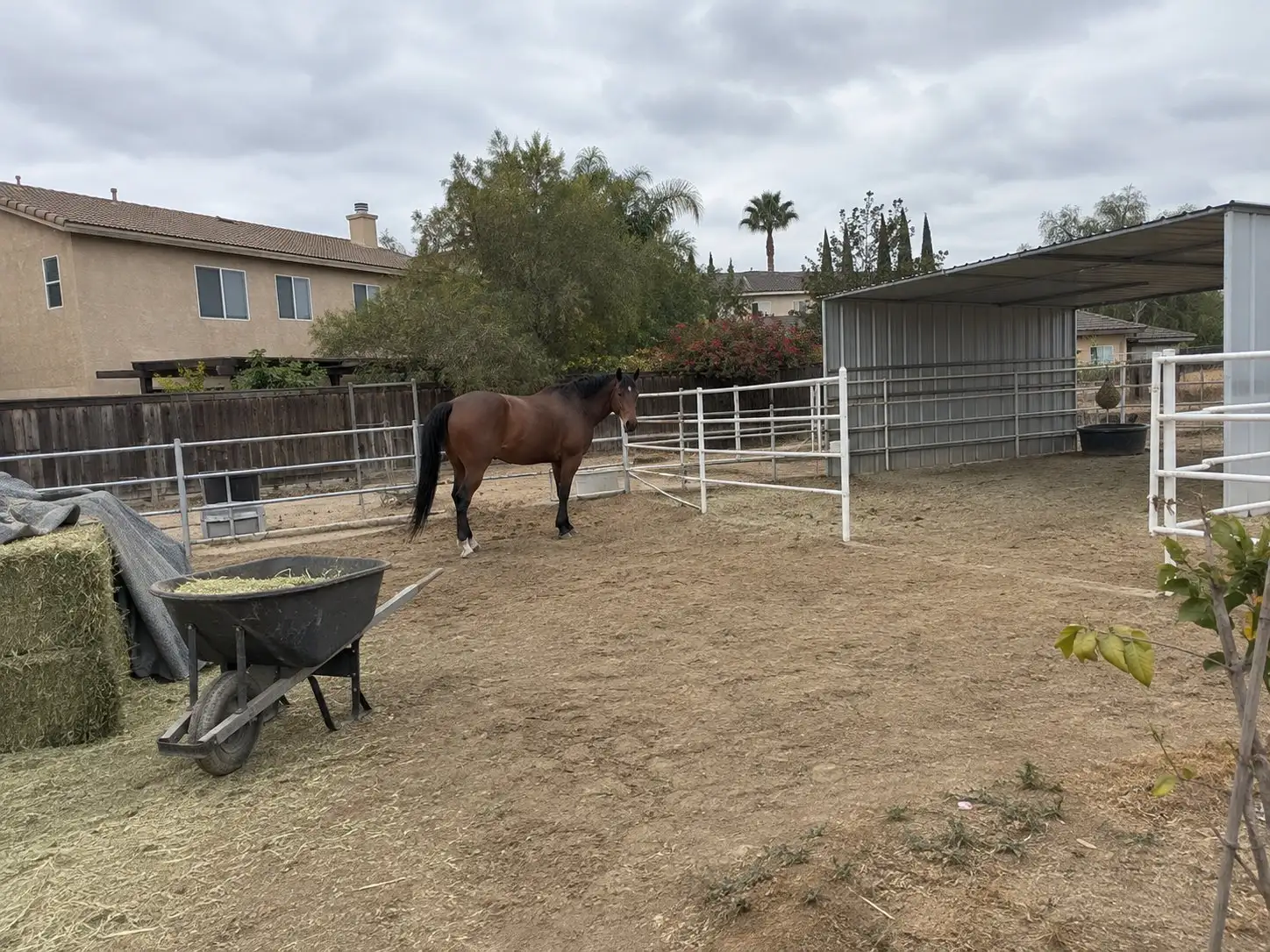
Norco calls itself Horsetown USA, and it earns the name. There are horse trails instead of sidewalks on many streets, hitching posts outside some businesses, and a city seal with a horse on it under the motto “City Living in a Rural Atmosphere.” What that image leaves out is that horse-keeping rights are not automatic. They come from zoning, from a minimum lot size, and on newer subdivision lots from a specific piece of the yard called a PAKA. Buyers who assume a Norco address means “I can keep a horse” sometimes find out otherwise after they’ve already fallen for the house.
What zone your lot is in decides everything
This is the first thing to check, before square footage or price. Norco’s animal-keeping capacity is written into zones like A-1 Agricultural Low Density, and into an Animal-Keeping Overlay that can apply to some R-1-10 lots. A property zoned plain R-1 with no overlay does not get to keep a horse just because it sits two streets from a trail. The zoning map is public, and city planning staff can confirm a specific parcel’s zone. Do this before you get attached to a listing photo of a backyard barn.
The A-1 zone and its lot-size suffixes
Norco’s A-1 zone is split into sub-zones identified by a numeric suffix on the zoning map, and that suffix sets the minimum lot size. A suffix of 20 or higher means thousands of square feet, so A-1-20 is a 20,000-square-foot minimum. A suffix under 20 means acres, so A-1-2 is a two-acre minimum and A-1-5 is five acres. For lots created after September 2014, the code sets the A-1 minimum at 21,780 net square feet, roughly half an acre, and requires a flat pad area of at least 19,600 square feet. Older lots that predate that ordinance can still qualify at the prior 20,000-square-foot standard. The suffix on the map for the specific parcel is the number that matters, not a general sense that “it’s zoned agricultural.”
How many animals a lot can actually keep
Assuming the zone allows it, the number of animal units permitted climbs with lot size on a defined schedule. In the A-1 zone, a lot between 20,000 and 25,000 square feet is allowed five animal units, one between 25,000 and 30,000 gets six, and the count keeps stepping up as the lot gets bigger. Smaller, legally nonconforming A-1 lots under 20,000 square feet use a separate, lower table, starting at one animal unit on a lot between 10,000 and 12,500 square feet. One horse equals one animal unit. Two miniature horses, two sheep, two goats, or two alpacas each also equal one unit, and young offspring under a listed age limit don’t count against the total.
Space and distance rules that apply regardless of zone
Two standards run through the animal-keeping code no matter which zone applies. No animal unit can be kept on a lot that lacks at least 500 contiguous square feet of usable, low-slope land for each unit. And no animal unit can be kept closer than 35 feet from a habitable structure on an adjacent lot, unless the owner puts up a solid fence at least six feet high to screen the animal area from that structure. Swine get a stricter version: the 35-foot distance applies with no fencing exception. These are code minimums, not suggestions, and a lot that is technically zoned for horses can still fail one of them depending on where the barn or corral would actually sit.
What a PAKA is and why it matters on newer lots
Subdivision lots created in the A-1 zone are required to include a Primary Animal Keeping Area, or PAKA, and this is where a lot of confusion happens on newer Norco tracts. The PAKA has to be at least 2,728 square feet on a pad under 20,000 square feet, or 3,304 square feet on a larger pad. It has to sit in the rear yard on land sloping no more than 4 feet of drop for every 100 feet, be rectangular with a minimum 30-foot width, and stay at least 35 feet from a habitable structure on the neighboring lot. Non-animal structures are not allowed inside it, and animal-related structures inside the PAKA cannot cover more than two-fifths of its area without City Council approval. Access matters too: the code requires a minimum 15-foot-wide, flat, clear route to the PAKA measured from the eave line, with overhead covers prohibited and any access gate at least 12 feet wide. The PAKA gets recorded on the lot and, where applicable, written into the project’s CC&Rs. If you are looking at a home in a subdivided A-1 tract, ask whether the recorded PAKA is intact, or whether a prior owner built a pool, a shed, or an addition into it. That kind of encroachment is exactly the sort of thing that should turn up as unpermitted work if it was added without a permit and disclosed accordingly.
The Animal-Keeping Overlay on R-1-10 lots
Some R-1-10 lots carry an Animal-Keeping Overlay, shown on the zoning map as something like R-1-10 (AKO-1). The overlay layers animal-keeping rights on top of the existing R-1-10 zoning, using a separate, smaller animal unit table than the A-1 zone, the same 500-square-foot and 35-foot standards, and one added condition: the property must be adjacent to a horse trail. Commercial boarding is not allowed under an AKO designation. If a listing isn’t in the A-1 zone but the agent says it “has horse rights,” the AKO designation and its trail-adjacency requirement are worth confirming directly rather than taking on faith.
The Equestrian Historic District does not add rules, it recognizes them
Norco has an Equestrian Historic District covering roughly 6,000 residential properties across the city’s animal-keeping zones, including HS, OS, LD, A-E, A-1-10, A-1-20, and A-1-40, plus a stretch of commercial frontage on Sixth Street. It is worth knowing about because it signals which parts of town share this character, but by the city’s own description it does not impose any new requirements or restrictions beyond the zoning that already applies. It is a recognition of heritage, not a separate regulatory layer, so it should not be confused with the zone-by-zone rules that actually control what you can keep on a given lot.
The trail system, and why access matters as much as zoning
Norco’s horse trail network is formalized in a Comprehensive Trail Master Plan and a Horse Trail Atlas maintained by the city, and trail-adjacency is a stated requirement for at least one path to animal-keeping rights, the AKO overlay. Beyond the legal requirement, trail access changes how usable the property actually is day to day. A horse-zoned lot boxed in from the trail system by fencing, a busy street, or a neighboring parcel with no easement is a very different property than one with a gate that opens straight onto a trail. Ask specifically how the property connects to the trail network, not just whether the neighborhood has one somewhere nearby.
What to check before you write an offer
Confirm the zone and its suffix on the city’s zoning map, not from the listing description. If the lot is in the A-1 zone, check whether it has a recorded PAKA and whether that area is still open and intact, since additions and outbuildings sometimes eat into it over the years. If the property relies on an Animal-Keeping Overlay instead, confirm the AKO designation and the required trail adjacency. Walk the setbacks: measure roughly 35 feet from any existing or planned animal area to the nearest neighboring home, and note whether a six-foot solid fence is already there if the distance is short. Ask about existing barns, stalls, corrals, and fencing, and whether they were permitted, since animal-keeping structures over 864 square feet in the A-1 zone need a minor conditional use permit. A pre-listing inspection or a buyer’s own walkthrough is the place to raise those questions directly, before they turn into a surprise in escrow. If the PAKA is recorded in the property’s CC&Rs, it’s also worth reading alongside the rest of an HOA disclosure package, since recorded restrictions can layer on top of what the zoning code already requires.
The short version
Horsetown USA is a real identity, but horse-keeping rights on any given Norco lot come down to the zone, the lot size, and, on subdivided A-1 lots, a recorded PAKA that meets specific size and setback rules. The Equestrian Historic District recognizes that character without adding new rules of its own. None of this is guesswork. It is public record on the zoning map and in the Municipal Code, and it is worth checking before you assume a backyard can do what the neighborhood suggests it can.
If you are weighing a Norco purchase or sale and want the zoning, the lot, and everything else read carefully before you commit, start with the home value tool.
Common questions
Can every home in Norco keep a horse?
No. The right to keep a horse comes from the lot's zone and its size, not from being located in Norco. A property has to be in a zone that allows animal keeping, such as A-1, and it has to meet that zone's lot size and setback rules before an animal unit is legally permitted there.
What is a PAKA?
A Primary Animal Keeping Area, a defined space the Norco Municipal Code requires on subdivision lots created in the A-1 zone. It has to sit in the rear yard on flat land, be rectangular, meet a minimum size, stay 35 feet from a neighbor's habitable structure, and have dedicated vehicular access, and it gets recorded on the lot.
Does being in the Equestrian Historic District change what I can do with my property?
No. The city's own description of the district says it does not add any new requirements or obligations beyond the zoning already in place. It is a designation that recognizes roughly 6,000 properties across Norco's animal-keeping zones, not an additional layer of rules.
How many horses can I keep on my lot?
It depends on the zone and the lot's size in square feet, measured against the Municipal Code's animal unit tables. A-1 lots use one table, the R-1-10 Animal-Keeping Overlay zone uses a different, smaller one, and every animal unit still needs 500 contiguous square feet of usable land and the required setback from a neighboring home.
Should I verify horse-keeping rights before writing an offer, not after?
Yes. Zone, lot size, and PAKA status are public record and worth checking before you fall for a property, not after you are in escrow assuming something the code does not actually allow.
