



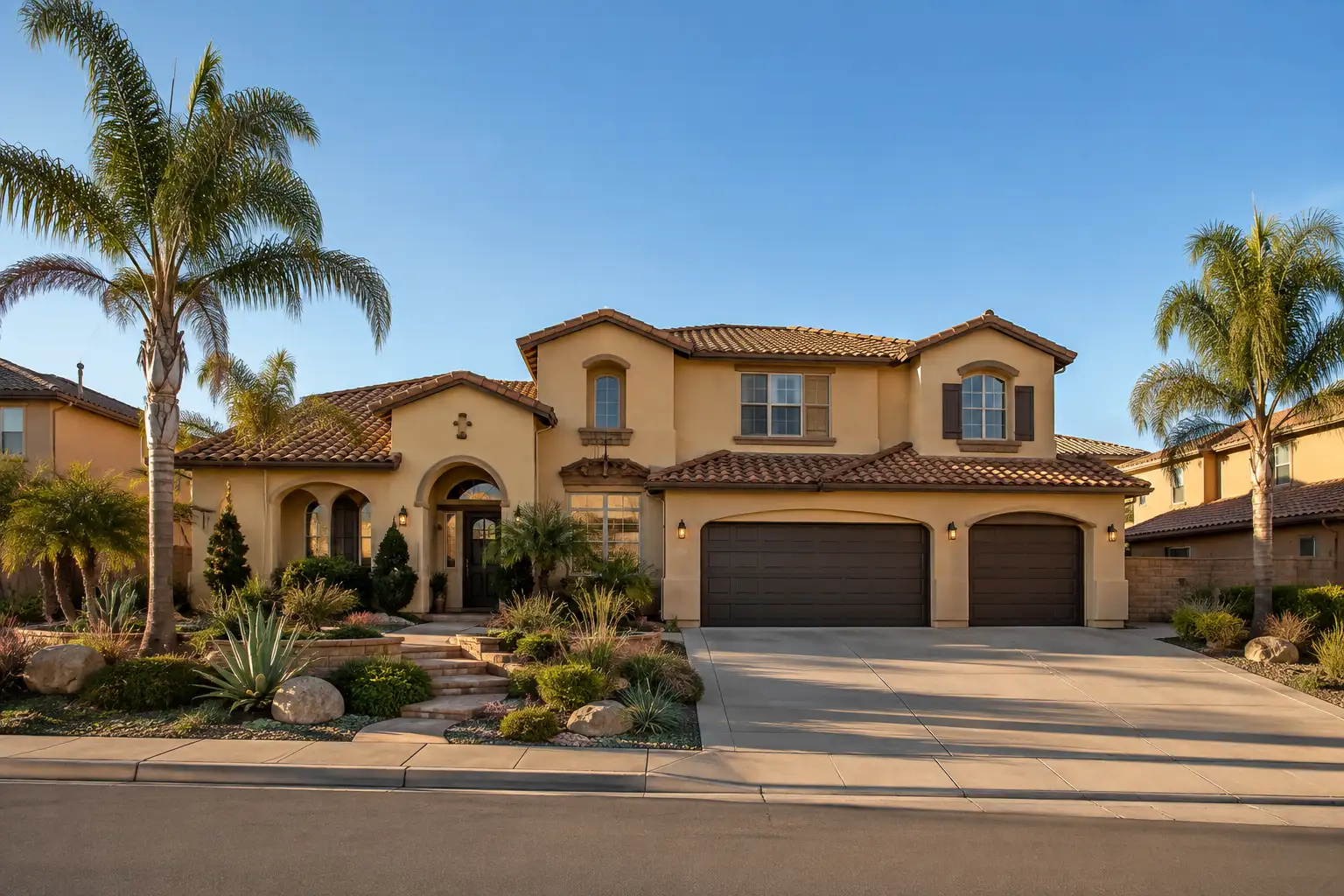
Cathedral City owners and buyers hearing about the city’s zoning rewrite should start with their parcel’s district and intended use. If adopted, the Development Code would replace Title 9, the city’s planning and zoning code, with updated districts, development standards and review procedures. Its provisions cover questions ranging from building height to vacation rentals and appeals.
For a purchase, sale or development proposal, read the new zoning map alongside the standards for the property. A citywide update does not tell you which provisions apply to an individual parcel.
This is general information and not legal advice.
Has the new Development Code been adopted?
The ordinance was scheduled for second reading on 28 October 2026. As of 29 October, minutes for the 14 and 28 October meetings were not posted, so the vote result and effective date are not verified. Confirm the result with the City Clerk at 760-770-0322.
First reading appeared on the 14 October Council agenda. The 28 October agenda placed item 3.I, “Second Reading an Ordinance Adopting a Comprehensive Development Code Update,” on the consent calendar. It recommended a second reading by title only and adoption of an ordinance repealing and replacing Title 9.
According to the 14 October staff report and ordinance text, the update implements the 2040 General Plan, adopted in July 2021. Objectives include responding to state housing laws with objective design standards, overhauling commercial zoning and streamlining development review.
What should you check about your parcel’s district?
Check your parcel on the new zoning map because the update consolidates several districts and introduces others. District names and abbreviations matter when locating the applicable use table and development standards.
R20-L and R20-H are consolidated. Two commercial zones (PLC and PCC) merge into General Commercial. MXC and DRN merge into Mixed-Use Downtown, or MU-DT, while NBP2, BP and PPO merge into Professional Office.
Mixed-Use Neighborhood, Mixed-Use Urban and Light Industrial, labeled MU-N, MU-U and I-1, come from the North City and North City Extended Specific Plan Areas. Staff describe those areas as having lacked development standards.
These changes do not establish that any particular parcel’s allowed use has changed. Read the map and use table together rather than relying on a district name alone. The project website provides another source of information about the update.
We were helping an owner evaluate an addition when Cathedral City’s new Development Code took effect. He had already researched the previous zoning standards and assumed the same setbacks and review process would still apply. We went back through the updated code because a zoning overhaul can change both what is allowed and how an application is reviewed.
What would change for mixed-use and multi-unit projects?
If adopted, the final Division 2 text would allow a maximum structure height of 70 feet for qualifying mixed-use and multi-unit development in MU-DT.
That provision does not establish a 70-foot height limit for single-family homes or every property in Cathedral City. A buyer considering development should check the district and whether the proposed project qualifies under the provision.
Allowable density also differs by district:
- MU-DT: 20 to 36 dwelling units per acre.
- MU-N: 10 to 25 dwelling units per acre.
- MU-U: 30 to 45 dwelling units per acre.
Read each figure with its district’s standards. A density range alone does not answer every question about a proposed project.
For environmental review, an Addendum to the General Plan EIR was prepared, and the ordinance text finds the ordinance exempt from CEQA. Those findings concern the code update; they do not describe conditions on an individual property.
What does the code say about vacation rentals and ADUs?
The proposed code prohibits short-term vacation rentals outside the Resort Residential district. Separate accessory dwelling unit standards state that an ADU shall not be used as a short-term vacation rental.
Staff call the district prohibition “consistent with the Ordinance,” referring to the city’s existing short-term rental ordinance. This article does not describe permit counts or fees.
A short-term vacation rental is defined as a rental for thirty consecutive calendar days or less. In the use table covering MU-DT, RR, MU-N and MU-U, that use is marked permitted only in RR. Resort Residential’s allowable density is 3 to 6.5 dwelling units per acre.
For related reading, see the ADU rules guide and Cathedral City’s air-conditioning rule for homes and rentals.
Would data centers be allowed?
If adopted, the code would prohibit data centers citywide. Staff say concerns raised during public comment led Cathedral City to define the use and include the prohibition.
Section 9.300.060 defines a data center as a facility whose primary use is operating servers and associated equipment for storing, processing, managing or transmitting digital data.
Readers following this subject elsewhere can consult the Hawthorne data-center moratorium guide for another city’s rule. Cathedral City’s provision is a citywide prohibition in the code presented for adoption.
Where would the fire-hardening standards apply?
Chapter 9.20.D places the quoted fire-hardening standards under a heading for the CR and RE zoning districts. They should not be described as requirements for every district.
For developments in those districts, the text requires eaves and soffits to be enclosed with non-combustible or ignition-resistant materials. Examples include metal, stucco and fiber cement.
Attic vents and grates must be fire-resistant, including mesh screens with openings no greater than 1/8 inch.
Owners checking proposed work should bring the property’s district designation and the work description to the city. This passage supplies development standards, not an inspection finding about an existing structure.
How would approvals and appeals work?
If adopted, Division 3 would introduce objective design standards for multi-unit and mixed-use developments and a process for ministerial approvals. Staff explain that proposals meeting the minimum design standard criteria can be approved without discretionary city review.
Written appeals would be due within 12 business days of the action. For a Director decision, the appeal period begins when the decision is posted on the city’s website. Check that posting date promptly when following a decision.
During its review, the Planning Commission increased the appeal period from 10 to 12 business days. It also recommended that staff look at lowering or eliminating the appeal filing fee and report back in 2027.
Staff said an administrative decision webpage and interested parties email list would launch by the end of November 2026.
Council or the Planning Commission could also order a de novo review of a Director decision by majority vote, in the same manner as if an appeal had been filed.
What else would move into the code?
Division 5 would place Cathedral City’s subdivision regulations directly in the municipal code for the first time. Since incorporation in 1981, the city has relied on Riverside County subdivision regulations adopted by reference.
Drive-through provisions also received Planning Commission changes. Commissioners removed the rule limiting drive-through facilities to designated arterial roadways. In MU-DT, drive-in and drive-through sales require the establishment of a primary use.
Staff describe an update process lasting more than two years, including Council and Commission study sessions, a zoning code seminar, two community workshops, three community walking tours and an online survey.
The short version
Start with your parcel’s district, then check the provisions for your intended use. If adopted, the code would combine several zoning districts, prohibit data centers citywide and change development review procedures.
For housing proposals, pay attention to the qualifying MU-DT height provision and district density ranges. For rental plans, read both the vacation-rental provisions and the ADU standards. CR and RE owners should also review the fire-hardening language.
These provisions do not predict property values or establish what a particular parcel can accommodate.
If you’re preparing to sell, start with the home value tool.
Common questions
What would Cathedral City's new Development Code replace?
If adopted, the Development Code would repeal and replace Title 9, the city's planning and zoning code.
Would the code allow data centers?
If adopted, the code would prohibit data centers citywide.
Does the 70-foot height limit apply to single-family homes?
The provision is for qualifying mixed-use and multi-unit development in the Mixed-Use Downtown district. It does not establish a 70-foot height limit for single-family homes.
Would an ADU be allowed as a short-term vacation rental?
The proposed accessory dwelling unit standards state that an ADU shall not be used as a short-term vacation rental.
