


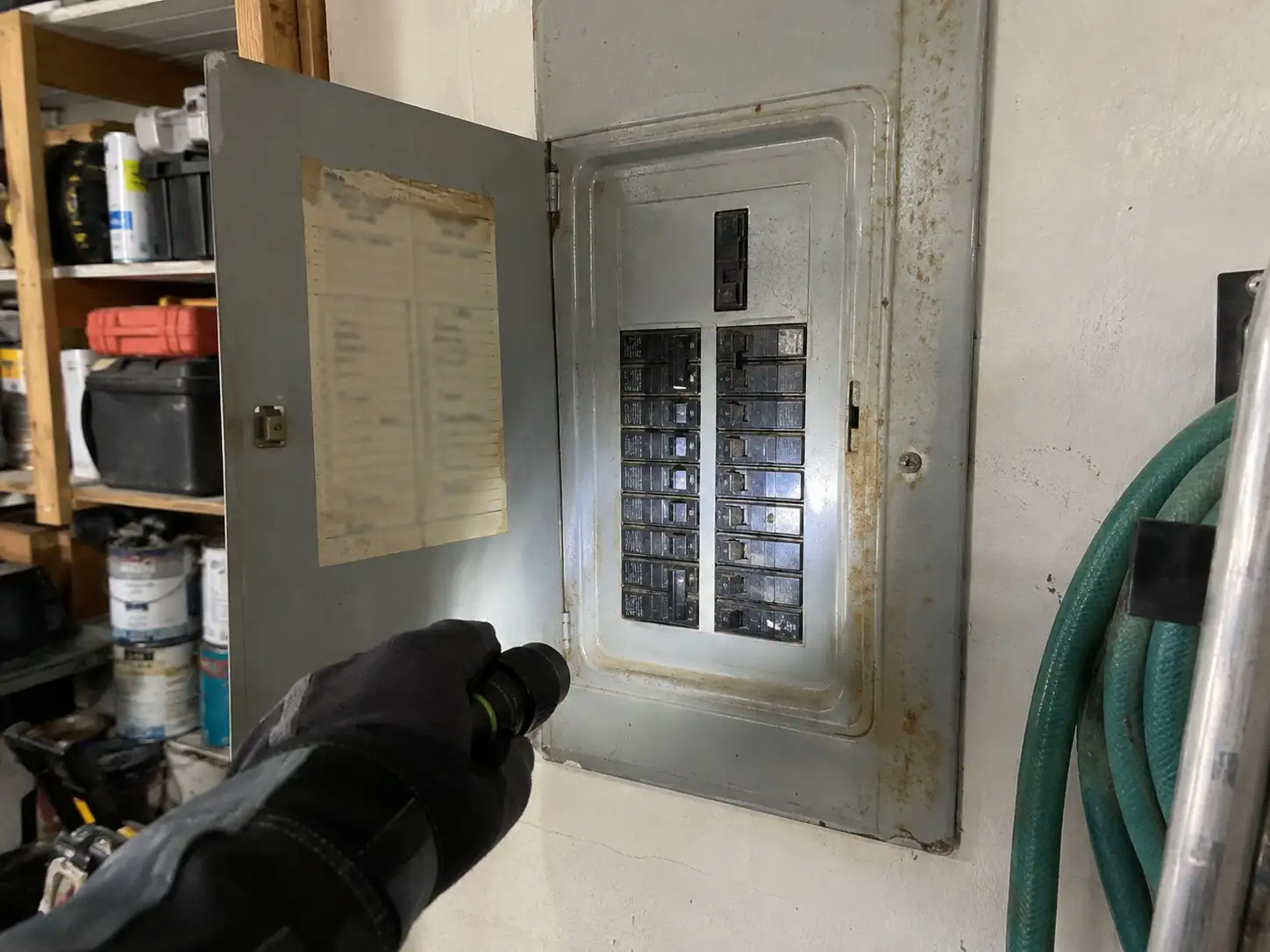
If your Escondido home still has its original electrical panel and the label inside the door says Federal Pacific Electric, FPE or Stab-Lok, you have the panel this article is about. It won’t stop your sale by itself. What it will do is show up twice, once in the buyer’s inspection report and again when the buyer tries to insure the house, and both times it changes the conversation.
What a Federal Pacific panel actually is
Federal Pacific Electric made residential circuit breaker panels and breakers under the Stab-Lok name from roughly the early 1950s into the early 1980s, and they were widely installed in homes built in that stretch. If your Escondido home dates to that window and the panel has never been swapped, there’s a real chance this is what’s behind your panel cover.
The concern isn’t cosmetic. A breaker’s job is to trip and cut power when a circuit is overloaded or shorted. Independent engineers and forensic investigators have raised long-standing questions about whether Stab-Lok breakers do that reliably, and the industry’s own standard for how a breaker is supposed to perform, Underwriters Laboratories testing under UL 489, is the benchmark these breakers are measured against. I’m not going to hand you a failure percentage, because the numbers that circulate online vary widely and I can’t verify any single one. What I can tell you is that this is not a brand anyone in the inspection or electrical trade treats as business as usual.
Why the Consumer Product Safety Commission never issued a recall
Buyers sometimes ask why, if the panel is really a problem, there was never a recall. There’s an answer, and it’s not reassuring. The U.S. Consumer Product Safety Commission opened an investigation into Stab-Lok breakers and closed it in 1983 without recalling the product. The commission’s own later statement on that closure said it was made without a determination as to the safety of the breakers, and the commission cited its limited budget as a factor in not pursuing the case further. No recall isn’t the same thing as a clean bill of health. It’s an open question the government stopped funding an answer to.
Separately, a New Jersey court found in a consumer fraud case that Federal Pacific Electric had cheated on the testing it used to get its breakers certified to meet UL standards in the first place. That ruling is about the company’s conduct decades ago, not a statement about how any individual panel is performing in your house today, but it’s part of why this brand carries a reputation the average old panel doesn’t.
What a buyer’s inspector will do with it
A buyer’s inspector who removes the panel cover is going to identify the brand, and Federal Pacific is easy to identify once the cover is off. The brand name is printed on the panel, and inspectors know the Stab-Lok breaker style on sight. Expect the report to name the brand specifically and recommend an evaluation by a licensed electrician, not a vague “aging panel, monitor” line. That single sentence is the one that changes how a buyer reads the rest of your report, whether or not the panel has ever actually failed.
If you’d rather see that sentence before a buyer does, a pre-listing inspection puts it in front of you on your own timeline, while you still get to decide what to do about it.
The insurance step, which is where deals actually stall
The inspection finding is one thing. The bigger problem shows up when your buyer applies for homeowner’s insurance. Some carriers may decline to write a new policy on a home with a known Federal Pacific panel, and others may write one with conditions attached, such as replacing the panel. Every carrier handles it differently, which is exactly why the buyer needs to get a real quote during their contingency period rather than assuming it will sort itself out. If a standard carrier won’t touch the property, buyers in higher-risk areas sometimes end up looking at the California FAIR Plan as a fallback, and that’s a materially different, and usually more limited, kind of coverage.
A lender that requires proof of insurance before funding can stall right along with the buyer’s insurance search, so this isn’t only the buyer’s problem to solve quietly on their own. It’s a timeline risk for your whole escrow.
What you have to disclose
If you know the panel is a Federal Pacific Stab-Lok, that’s a known fact about your electrical system, and California’s Transfer Disclosure Statement asks you directly about known defects in the electrical system under Civil Code section 1102.6. Checking “no issues known” when you know what brand is behind that cover is the kind of thing that comes back on you later, whether through the buyer’s attorney or simply through a blown deal when the omission surfaces at the worst possible moment. The seller disclosure guide walks through what else the form asks for.
Disclosing it early isn’t a weakness in your negotiating position. It’s what lets you control the timing instead of reacting to it.
Your options before you list
You have more paths than “replace it” or “say nothing.” Each one trades money now against certainty later.
The first is to get a licensed electrician to evaluate the panel and, if it’s a Federal Pacific Stab-Lok, get a bid to replace it before you list. A permitted replacement in hand is a strong answer to any buyer’s question, and it removes the insurance uncertainty before it ever becomes your buyer’s problem.
The second is to disclose it, price the home with it in mind, and let the buyer decide whether to replace it themselves or ask for a credit. This is a legitimate approach as long as you’re doing it on purpose, with the disclosure filled out honestly, rather than hoping nobody asks.
The third is to get ahead of the insurance question specifically. Even if you don’t replace the panel, knowing in advance which local carriers will and won’t write a policy on the house, and being able to tell your agent that answer, saves your buyer’s side real time in escrow.
Whichever way you go, get the electrician’s evaluation in writing. A verbal “it looks fine” from a friend of a friend won’t hold up in a negotiation, and it won’t satisfy a buyer’s inspector either.
Permits if you replace it
If you decide to replace the panel, the City of Escondido requires a building permit for electrical service panel work, and it has to be pulled by a licensed electrician. Skipping the permit to save a step just trades one disclosure problem for another, because unpermitted work is itself something you’d have to disclose, and it’s exactly the kind of thing a buyer’s inspector or appraiser notices. A permitted replacement, with the final inspection signed off, is the version of this story that actually closes the loop for a buyer’s insurance carrier and lender.
The short version
A Federal Pacific panel in your Escondido home isn’t a reason to panic, and it isn’t something you can quietly wait out either. It’s a known item that a buyer’s inspector will name specifically, and it’s a question their insurance carrier will ask before the loan funds. Know which one you have, know what it would cost and take to replace it, and decide on purpose how you want to handle it in your disclosure. That’s a much better position than finding out where your buyer’s insurance stands three days before closing.
If you want the panel, the roof, and everything else looked at with an inspector’s eye before you set a price, start with the home value tool.
Common questions
Can I sell my Escondido home with a Federal Pacific panel still in it?
Yes. Nothing in California law requires you to replace the panel before you sell. What you can't do is hide it. If you know the panel is a Federal Pacific Stab-Lok, that goes on your disclosure, and most buyers will find out anyway once their inspector opens the panel.
Will a home inspector flag a Federal Pacific panel automatically?
A competent inspector will identify the panel brand as part of a normal electrical inspection, and the Federal Pacific or Stab-Lok name on the panel label is easy to spot once the cover is off. Expect the report to note the brand and recommend an electrician evaluate it.
Does my homeowner's insurance policy get cancelled if I have this panel?
Your own policy as the seller isn't the issue here, your buyer's new policy is. Some carriers may decline to write a fresh policy on a home with a known Federal Pacific panel, or attach conditions to it. Ask your own agent what your carrier's position is, since it can affect a refinance too.
Do I need a permit to replace the panel before I sell?
Yes. The City of Escondido requires a building permit for electrical panel replacement, pulled by a licensed electrician. Replacing it without one creates a new disclosure problem in place of the old one.