


The tiles on most Temecula tract roofs look fine from the street, and a lot of them genuinely are fine. That’s the trap. On a concrete tile roof, the tile is not the part that keeps water out of the house. The layer underneath does that job, and it ages on a completely different clock.
If you’re getting ready to sell a home built in the 1990s or 2000s, this is one of the few big-ticket items you can’t judge by looking at it, which is exactly why it tends to surface for the first time in the buyer’s inspection report.
What the underlayment actually does
The underlayment is the waterproof layer, and the tile mostly sheds water off the top of it. The industry’s own installation manual, published by the Tile Roofing Industry Alliance, describes a tile roof as a water-shedding assembly and says it performs only when every component under the tile is installed properly. Rain that gets blown up under the tile, runs through a cracked piece or backs up at a valley is supposed to meet the underlayment and run off. When that layer is intact, a few broken tiles are an annoyance. When it isn’t, they’re a leak.
California’s residential building code treats it that way too. Clay and concrete tile has to go on a roof pitched at least 2½ in 12, over underlayment that meets the code’s standard, and on the lower-pitched range of tile roofs the code calls for two layers of it.
Why it wears out long before the tile
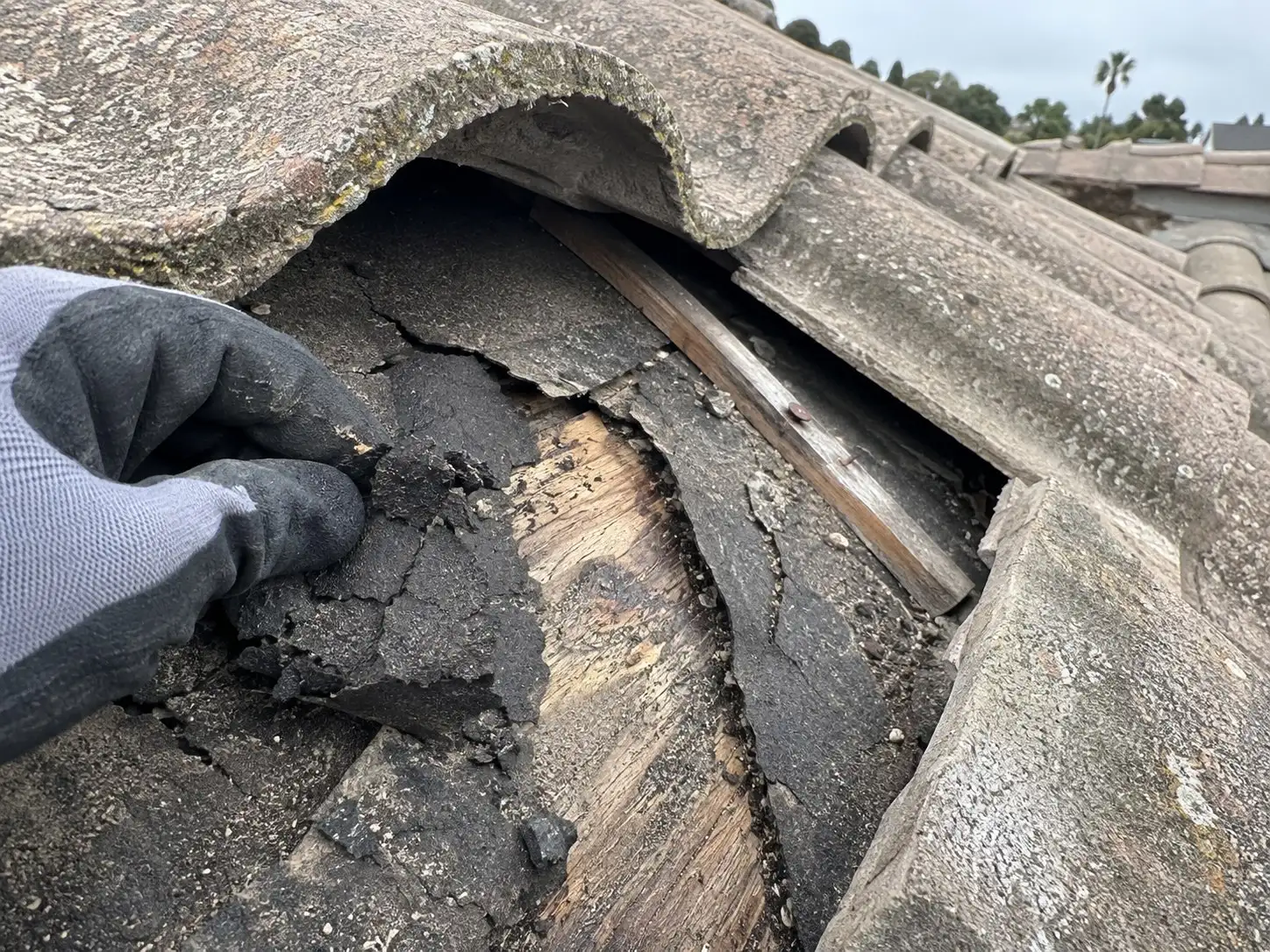
Concrete tile is marketed to last for the life of the structure. The felt under it is a different material with a different life. Most original roofs from this era were laid over asphalt-saturated organic felt, the product ASTM D226 covers, usually the heavier “30 pound” grade. It starts out flexible and waterproof because it is soaked in asphalt. Over years of heat trapped under the tile, it dries out, turns brittle and starts to crack, first where it was nailed and at the eaves, where leaves and grit hold moisture against it.
Temecula summers don’t help. A roof that sits in inland heat season after season is cooking that felt from above, every year.
There is no published expiration date for felt underlayment. I’d be suspicious of anyone who gives you an exact number of years. What I can tell you is when it deserves attention: once the original underlayment passes about 20 years, it’s worth someone actually looking at it instead of assuming.
Why this is a Temecula question right now
Much of Temecula’s tract housing went up across the 1990s and 2000s, so a lot of these roofs are reaching that window at the same time. Redhawk was built out between 1995 and 2003. Harveston went up between 1999 and 2005. If your home is original to either, and the roof has never been redone, the felt under your tile is somewhere between 20 and 30 years old today.
That doesn’t mean it has failed. Plenty of these roofs have years left. It means a buyer’s inspector is going to look at the age, and a buyer’s agent is going to ask the question, whether or not you have an answer ready.
Signs you can check without climbing on the roof
You don’t need to walk on tile to get a read on it, and I’d rather you didn’t. Concrete tile cracks underfoot if you step in the wrong place. Start with what you can see from the ground and from inside.
Look at the gutters after a good rain. Black, papery flakes mixed in with the leaves can be pieces of old felt breaking down and washing out. Look at the eaves from a ladder for slipped or cracked tiles, which also give you a peek at the layer under them.
Then go inside. Stains on the ceiling near exterior walls are worth taking seriously, especially in upstairs rooms. If you can get to the attic hatch safely with a flashlight, look up at the underside of the roof deck for dark water stains or soft-looking areas. None of these prove the underlayment is failing. All of them are reasons to have someone qualified look before a buyer does.
What a buyer’s inspection will likely say
A home inspector usually can’t lift every tile, and a good one won’t pretend otherwise. What they can see is the underlayment at the edges, at any slipped or broken tile, and from the attic. If it looks old or brittle there, the report will typically say so and recommend a licensed roofer evaluate the whole roof.
That sentence is the one that changes negotiations. A buyer reading “recommend evaluation by a licensed roofing contractor” on a 25-year-old tile roof starts pricing a new roof into their offer, whether the roof needs one or not. That’s not a conversation you want to have for the first time in escrow.
If you’d rather find out on your own schedule, a pre-listing inspection puts the same findings in front of you before a buyer ever sees them.
Your options before you list
You have more choices than “do nothing” or “new roof.” Each one trades money now against bargaining power later.
The first is to get a roofer’s evaluation before you list and simply know. Sometimes the answer is good news, and a written evaluation saying the underlayment still has life in it is a strong document to hand a buyer.
The second is targeted repair. If the damage is concentrated at the eaves or in valleys, where it usually starts, a roofer may be able to replace underlayment in those areas without redoing the whole roof.
The third is a full lift-and-relay. The tiles come off and get stacked, new underlayment goes down and the same tiles go back on, with cracked ones replaced. Because the tile is reused, you are mostly paying for labor and underlayment rather than a new roof covering. One practical catch on older roofs: matching replacement tiles for a profile and color that are 25 years old can take some hunting, so ask about it early.
The fourth is to leave it alone and price for it. That’s a legitimate choice, as long as you’re making it on purpose and not discovering it through a buyer’s report.
Whichever way you go, get written bids that spell out the scope, because the scope drives the price far more than the tile does.
Permits and disclosure
The City of Temecula requires a building permit for reroofing work, and a lift-and-relay is reroofing even though the same tiles go back on. If a roofer offers to skip the permit to save time, don’t. Unpermitted work is something you’d have to disclose later, and it’s exactly the kind of thing a buyer’s side asks about.
On disclosure generally: California’s Transfer Disclosure Statement, under Civil Code section 1102.6, asks sellers about known defects. The moment a roofer or inspector puts a finding about your underlayment in writing, it’s something you know. That isn’t a reason to avoid finding out. It’s the reason to find out early, when you still get to decide what to do about it. The seller disclosure guide walks through the rest of what the form covers.
The short version
The tile on your roof may well outlast you. The felt under it won’t, and on a Temecula home built in the 1990s or early 2000s, it’s old enough now that a buyer will ask about it. Know the answer before they do.
If you’re thinking about selling and want the roof and everything else read before you set a price, start with the home value tool. It’s the same inspector’s eye I’d bring to your house in person.
Common questions
How long does tile roof underlayment last?
There is no single published lifespan for it, and anyone quoting an exact number of years is guessing. It depends on the felt used, the roof's slope, how much heat the roof takes and how well it was installed. On Temecula tracts built from the mid-1990s to the mid-2000s, the original underlayment is now 20 to 30 years old, which is the age when it deserves a close look.
Can the underlayment be replaced without replacing the tile?
Yes. It is called a lift-and-relay. The tiles come off and get stacked, new underlayment goes down, and the same tiles go back on, with broken ones replaced. It is still reroofing work, and the City of Temecula requires a building permit for it.
Do I have to disclose worn underlayment when I sell?
If you know about it, yes. California's Transfer Disclosure Statement asks sellers about known defects, and a roofer's or inspector's written finding on the underlayment is exactly the kind of thing you would then know.
Will the buyer's home inspector find it?
Often, at least partly. An inspector can usually see the underlayment at the eaves, at slipped or cracked tiles, and from the attic side of the roof deck, and will commonly recommend a roofer's evaluation when it looks old. A clean walk-through does not mean nobody will ask.